John’s revolt against soma distribution
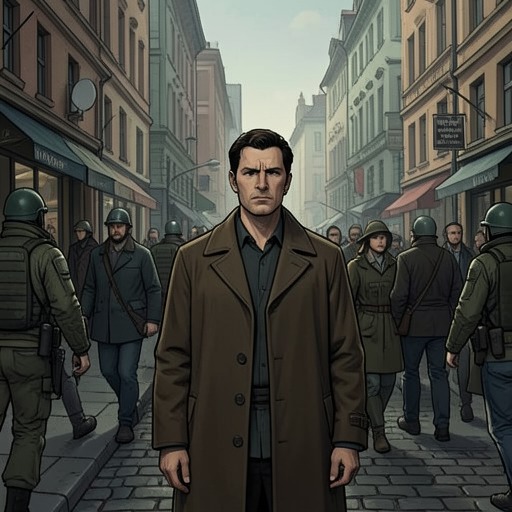
Brave New WorldJohn’s revolt against soma distribution is the confrontation at the Park Lane Hospital for the Dying in which he tries to stop the Delta staff receiving their daily soma ration. Mourning Linda, he acts on his conviction that soma is poison and freedom requires rejecting it; but the workers’ anger, his friends’ divided responses, and the police’s carefully managed intervention turn his attempted liberation into a brief, contained riot. The episode makes the conflict between individual freedom and engineered social stability physically immediate, then shows the system absorbing the disturbance and returning the crowd to its routine.
Causes and Setting
The revolt begins after John has left Linda’s bedside. He is grieving and remorseful, and the death has left him so inwardly absorbed that he initially moves through the hospital staff without fully registering them. At six, the 162 Delta workers assemble in the vestibule for their soma ration. They are divided into two Bokanovsky Groups: 84 red-haired women and 78 dark-haired men. The orderly distribution offers a stark contrast to John’s private grief: the hospital’s workday ends not in mourning but in a standardized communal ritual.
As the workers gather around the ration, their repeated faces bring John back to his surroundings. He sees their sameness as an affront to Linda’s death and to the singularity of his grief. The sight renews his horror at the world that has surrounded him since arriving in London. His revolt thus grows out of two linked pressures: the immediate loss of his mother and his broader rejection of the society that uses soma to manage feeling.
The Attempt to Stop the Distribution
A young Alpha opens a black iron cash-box to begin the distribution. The waiting Deltas respond together, their attention fixed on the box and its contents. John interrupts the routine by calling for them to stop, then pushes through to the table. Public speaking is unfamiliar to him, and his plea is halting at first: he asks the workers to refuse the drug, calls it poison to body and soul, and urges them to throw it away.
The workers do not respond to his appeal as he intends. His words reach them most sharply when he tells them to throw the soma away; the phrase breaks through their incomprehension and provokes an angry murmur. John turns to the crowd and says that he has come to bring them freedom. Yet the gap between his aim and their understanding widens as the scene continues. He regards refusal as the path to freedom, while the Deltas, accustomed to the distribution, treat his intervention as a threat to the familiar order.
Escalation and the Friends’ Responses
John follows his appeal with action. He throws handfuls of soma tablets out of an open hospital window into the inner court. For a moment the workers are silent with astonishment and horror at the destruction of what they regard as their ration. Then the crowd moves against him. Bernard watches in fear, expects John and Helmholtz to be killed, and initially turns away from the advancing Deltas.
Helmholtz makes the decisive choice to join John. He pushes through the crowd, reaches his side, and helps him throw the remaining tablets out of the window while striking back at their assailants. John calls the workers free when he holds up the empty cash-box. The gesture gives the revolt a visible climax: the supply has been emptied, but the declaration cannot make the Deltas accept the freedom he means. They charge with renewed fury.
Bernard’s response remains divided. He considers helping, draws back, and then steps forward again, caught between the danger to his companions and the danger to himself. When the police arrive, he runs toward them and shouts for help, but his urgency does not direct their response. A policeman uses an anaesthetic water pistol on him; Bernard becomes unsteady and falls. His wavering participation contrasts with Helmholtz’s direct commitment and leaves John and Helmholtz confronting the crowd without his effective support.
Suppression and Aftermath
The police restore order through a coordinated intervention rather than an ordinary appeal to the crowd. Three officers pump soma vapour from shoulder-mounted spraying machines. Others operate the portable Synthetic Music Box, while four policemen use water pistols charged with a powerful anaesthetic to subdue the more aggressive fighters. The state’s response combines chemical pacification, incapacitation, and recorded persuasion.
The music box plays a prerecorded anti-riot speech that addresses the crowd as friends and urges them to be happy, good, and at peace together. Two minutes later, the voice and soma vapour have produced their effect. The Deltas cry and embrace one another; even John and Helmholtz are nearly in tears. A fresh supply of soma arrives from the Bursary, and the workers receive another distribution before dispersing to the voice’s affectionate farewells. The cash-box John emptied is thus replaced by a new supply, and the disturbance ends with the ritual restored rather than with the workers’ conversion to his cause.
When the last Delta has left, a policeman switches off the current and the recorded voice falls silent. The authorities then take John, Helmholtz, and Bernard into custody. The revolt has not changed the distribution or freed the workers; it has instead exposed how quickly the World State can turn a public challenge into a controlled episode, using the same soma John rejected to pacify the crowd. At the same time, the friends’ contrasting actions clarify their positions: Helmholtz openly joins John, while Bernard’s concern is repeatedly checked by fear.
Significance
The episode stages a collision between freedom as John understands it and happiness as the World State administers it. John treats refusal as a moral choice and the destruction of the tablets as a break with dependence. The Deltas’ immediate anger and subsequent return to the distribution show that his declaration alone cannot undo the conditioning that makes soma reassuring and resistance incomprehensible to them.
The authorities’ methods make the reversal especially pointed. John removes soma from the scene, but the police restore compliance with soma vapour, anaesthetic, synthetic music, and a fresh ration. The system does not answer his argument; it manages the crowd’s response until the customary routine can resume. His claim that the Deltas are free is therefore both the revolt’s climax and its limit: the empty box proves that he has disrupted the supply, not that the workers have chosen liberation.